What if the path to genuine happiness begins with admitting you have nothing to offer?
That sounds backwards. Counterintuitive. Maybe even offensive. And that’s exactly the point.
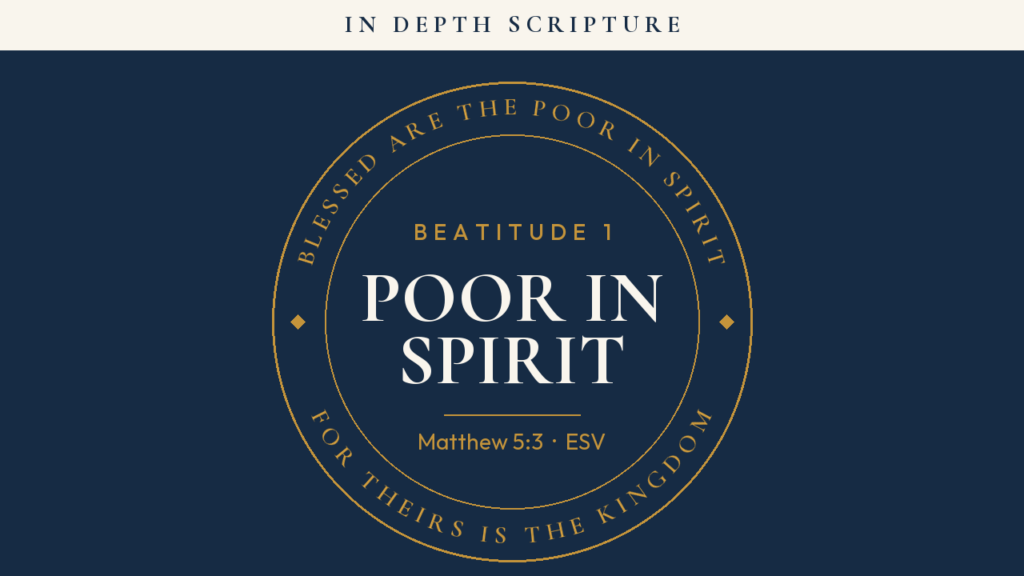
Jesus opens the Sermon on the Mount, his first and longest recorded sermon in Matthew with eight remarkable statements we call the Beatitudes. Each one begins with the word “blessed” and describes a quality of Christian character. The first one, the one that serves as the foundation for everything that follows, is this:
“Blessed are the poor in spirit, for theirs is the kingdom of heaven” (Matthew 5:3, ESV).
Setting the Scene
Before we unpack the words, it helps to understand the moment. By Matthew 4, Jesus is already drawing massive crowds from across the region, Galilee, Syria, Jerusalem, Judea, and beyond. He has been teaching, preaching, and healing with an authority no one had seen before.
Then he goes up on a hillside, most likely on the northeast shore of the Sea of Galilee, in a place that today bears the name the Mount of Beatitudes. He sits down. His disciples gather around him.
The act of sitting was significant. Rabbis sat to teach when they were about to say something authoritative. When Jesus sat, every person present understood: what comes next matters.
And what comes next is directed specifically at his disciples, to those who already believed. The Sermon on the Mount is not primarily an evangelistic appeal to outsiders. It is Jesus describing, from the inside out, what a life of genuine faith actually looks like.
What Does “Blessed” Really Mean?
The Greek word translated “blessed” is makarios. It doesn’t mean lucky, or prosperous, or given some external advantage. Makarios describes an inward state, a deep, settled joy and contentment that is not produced by circumstances and not undone by them either.
The Amplified Bible renders verse 3 this way:
“Blessed (happy, to be envied, and spiritually prosperous, with life-joy and satisfaction in God’s favor and salvation, regardless of their outward conditions) are the poor in spirit.”
This is the kind of happiness God himself possesses. First Timothy 6:15 applies makarios to God, the “blessed and only Sovereign.” Through Christ, we are invited to participate in that same divine happiness.
But here’s what the Beatitudes are not: a checklist. They are not merit badges to earn, boxes to tick, or spiritual accomplishments to post about. Think of them instead as floors in a building. You cannot reach the third floor without passing through the second. Each beatitude requires the ones before it and makes possible the ones that follow. The progression is intentional. And it all begins here.
Poor in Spirit: The Greek Word That Changes Everything
The word translated “poor” in verse 3 is the Greek ptochos. It doesn’t simply mean lacking in resources. It means beggarly, someone who crouches and cowers, utterly without standing of their own. It’s the same word Luke uses for Lazarus, the beggar lying at the gate of the rich man (Luke 16:20).
To be poor in spirit is to recognize, at the deepest level, that before a holy God you have nothing to bring. No righteousness of your own. No moral accomplishment sufficient to bridge the gap. You come to God the way a beggar comes to a king, empty-handed, without pretense, entirely dependent on mercy.
Now consider how radical this would have sounded to Jesus’s original audience. These were Jewish men and women who had built their entire religious identity around their adherence to the law. The most respected people in their world were the Pharisees, the ones who fasted twice a week, tithed precisely, and kept every regulation. And Jesus opens his sermon by saying that the truly happy ones are those who approach God like beggars.
That was not a comfortable message then. It isn’t a comfortable message now.
The Parable That Defines It
Jesus illustrates poverty of spirit in one of his most pointed parables, the Pharisee and the Tax Collector in Luke 18:9–14. Before he even tells it, Luke notes the audience it is directed at: those who “trusted in themselves that they were righteous, and treated others with contempt.”
The Pharisee’s prayer is, in reality, a performance. He thanks God that he is not like other people, the extortioners, the unjust, the adulterers, or the tax collector standing nearby. He lists his spiritual credentials: fasting twice a week, tithing everything. He places the weight of his standing before God entirely on his own achievement.
The tax collector cannot even look up. He beats his chest and says, “God, be merciful to me, a sinner.”
Which man goes home justified? The beggar.
This is poverty of spirit. It’s not false modesty or a performance of humility. It’s an honest assessment of where we actually stand before a perfectly holy God, and a refusal to dress that up.
This Isn’t Just for New Believers
It’s easy to think of poverty of spirit as something we experience once, at the moment of conversion, and then then move past. But that misreads Jesus’s intent entirely.
Consider the Apostle Paul. Few people in the history of the church have borne more spiritual fruit. And yet in Romans 7, Paul describes a daily battle with sin. In 1 Timothy, written near the end of his life, he still calls himself the chief of sinners. Not “was.” Is.
The pattern is consistent throughout Scripture: the more we grow in Christ, the more clearly we see our own sin. Spiritual maturity doesn’t produce pride. It produces deeper humility.
This is why Martin Luther said that the entire Christian life is a continuous act of repentance. Poverty of spirit isn’t the entry point that you leave behind. It’s the permanent posture of a healthy soul.
When we forget it, when pride moves in, we start functioning like the Pharisee. We look at struggling people around us and feel superior. We compare our visible obedience to their visible failures. And in doing so, we forget the only reason we’re in a different position: God’s grace.
Romans 8:1 is the believer’s bedrock: “There is therefore now no condemnation for those who are in Christ Jesus.” That’s the good news. But it must never become a reason for pride. It must always remain a reason for gratitude and humility.
Why This Comes First
Jesus doesn’t open the Sermon on the Mount here by accident. Poverty of spirit is the ground floor. Everything else depends on it.
Think about what God did with Israel after the Exodus. He gave them an extensive code of law, dietary restrictions, ritual requirements, social regulations. The purpose? To set them apart. To make them visibly, structurally different from every surrounding culture.
The Beatitudes serve the same function for the followers of Jesus. They mark out a people who are fundamentally different from the world around them, not in external practices, but in the orientation of their hearts.
The world says pursue status. Accumulate credentials. Protect your reputation.
Jesus says: blessed is the one who comes before God with nothing.
And here is why that’s not a depressing place to begin: when you know you have nothing to prove, when you’re not spending your energy trying to earn what God has already freely given, you can finally rest. The beggar who has been given everything by the king doesn’t need to keep performing. He simply receives.
A Question to Sit With
When you approach God in prayer, in worship, in the quiet of an ordinary Tuesday, do you approach him like the Pharisee or the tax collector?
Are you presenting a resume, or are you coming empty-handed?
That question isn’t meant to produce guilt. It’s meant to produce freedom. Because the one who comes empty-handed is the one Jesus calls blessed.
To Close
This is the first post in our series working through the Beatitudes and the Sermon on the Mount. Next up: Blessed Are Those Who Mourn, and why genuine grief is the unexpected doorway to comfort.
If you’re a video learner, this post has a companion teaching on the In Depth Scripture YouTube channel.